Yefim Bronfman
Colburn Celebrity Recital
March 22, 2026 — Walt Disney Concert Hall
By Yann Perreau
Listening to Yefim Bronfman’s breathtaking recital at the Walt Disney Concert Hall, one is led to wonder whether genius is inherited—embedded in one’s DNA—or whether it can emerge through discipline, labor, and profound artistic influences. This perennial question, ultimately unanswerable beyond philosophical speculation, becomes strikingly immediate when confronted with an artist capable of performing, alone and with such authority, a program of such diversity and complexity as Bronfman’s this past March. Born in 1958, to two professional musicians—his mother a pianist, his father a concertmaster—Bronfman was already displaying formidable technique in his first performances, making his international debut at sixteen.
The recital opened with Schumann’s Arabeske, rendered with delicacy, tenderness, and a supple sense of phrasing. This intimate work served as a luminous prelude to the monumental architecture of Brahms’s Piano Sonata No. 3, his largest work for solo piano and his final sonata in the genre. In Bronfman’s hands, the sonata unfolded as a vast, spiraling structure—its four movements circling, tightening, and eventually releasing themselves, before returning, transformed, in the final movement. There was both rigor and volatility in this interpretation, revealing Brahms’s audacity as much as his structural mastery.
Debussy’s Images, Book II offered a striking contrast. Associated with Impressionism and Symbolism—though he resisted such labels—Debussy sought to “paint” with sound. Bronfman fully embraced this pictorial dimension. In Cloches à travers les feuilles, the bell-like opening motifs expanded into shimmering textures, growing into a luminous, almost windswept sonic landscape. Et la lune descend sur le temple qui fut carried a sense of mystery and antiquity, an atmosphere of suspended time—fitting for a work inspired by Debussy’s friend Louis Laloy, a scholar of ancient and Eastern cultures. Poissons d’or, with its fluid, iridescent movement, evoked not only aquatic life but also Debussy’s fascination with Asian art, inspired by a Japanese lacquer panel depicting golden fish.
The program culminated in Beethoven’s Piano Sonata No. 23—the Appassionata—delivered with electrifying intensity. Bronfman channeled the work’s turbulence with a physical and emotional commitment that bordered on the visceral. His hands and arms moved across the keyboard with ferocious energy, as if the instrument itself might not contain the force unleashed. The final movement, famously described by Carl Czerny, Beethoven’s pupil, as resembling “ocean waves on a stormy night, with a distant cry for help,” reached a level of dramatic urgency that was both overwhelming and exhilarating.
Following a thunderous standing ovation, the pianist returned with three encores—Tchaikovsky’s “Autumn Song” from The Seasons, Liszt’s Grandes Études de Paganini, No. 2, and Prokofiev’s Precipitato from Piano Sonata No. 7—generously extending the evening. Although one felt that the audience would have gladly remained longer, suspended in the afterglow of such a commanding recital.
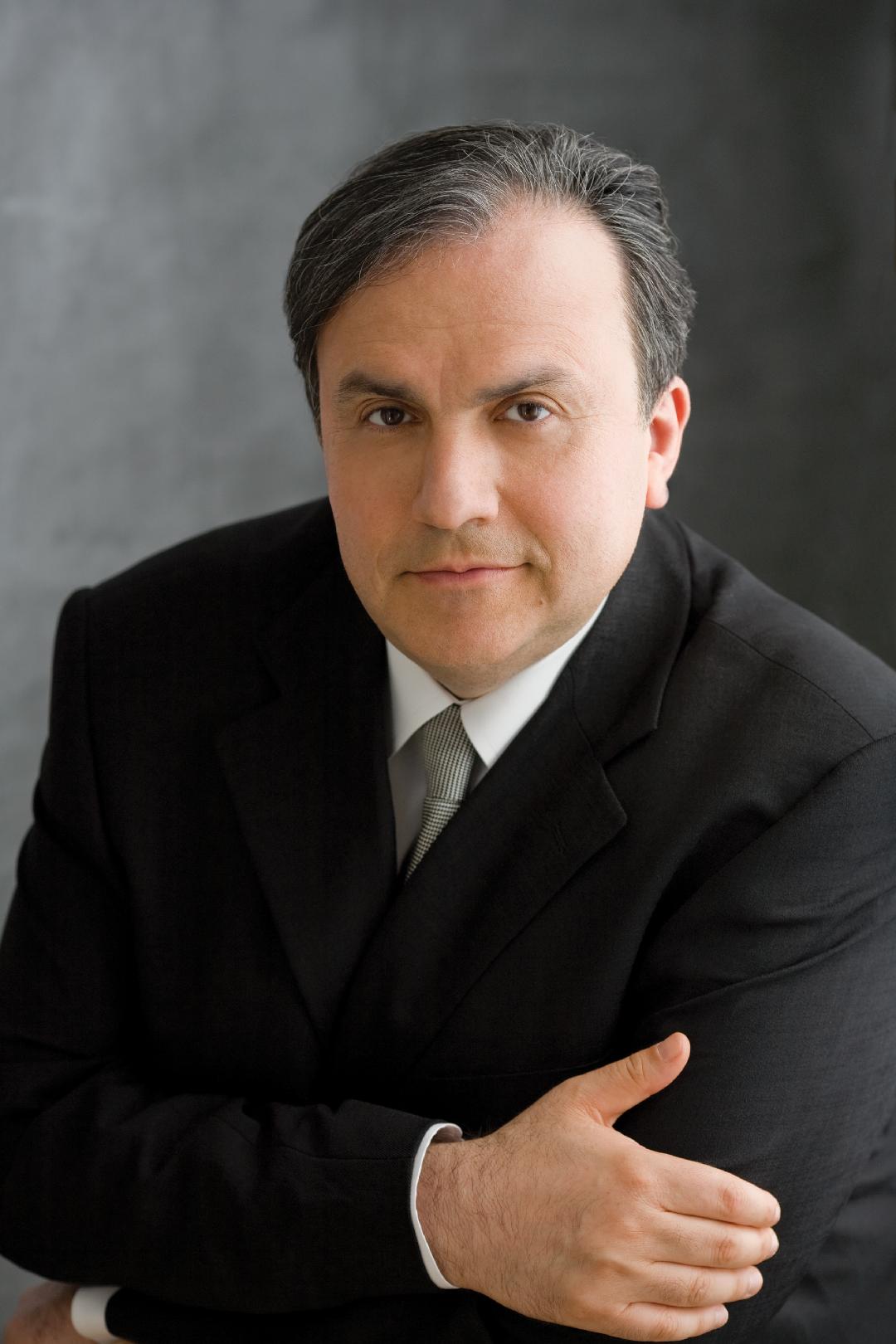
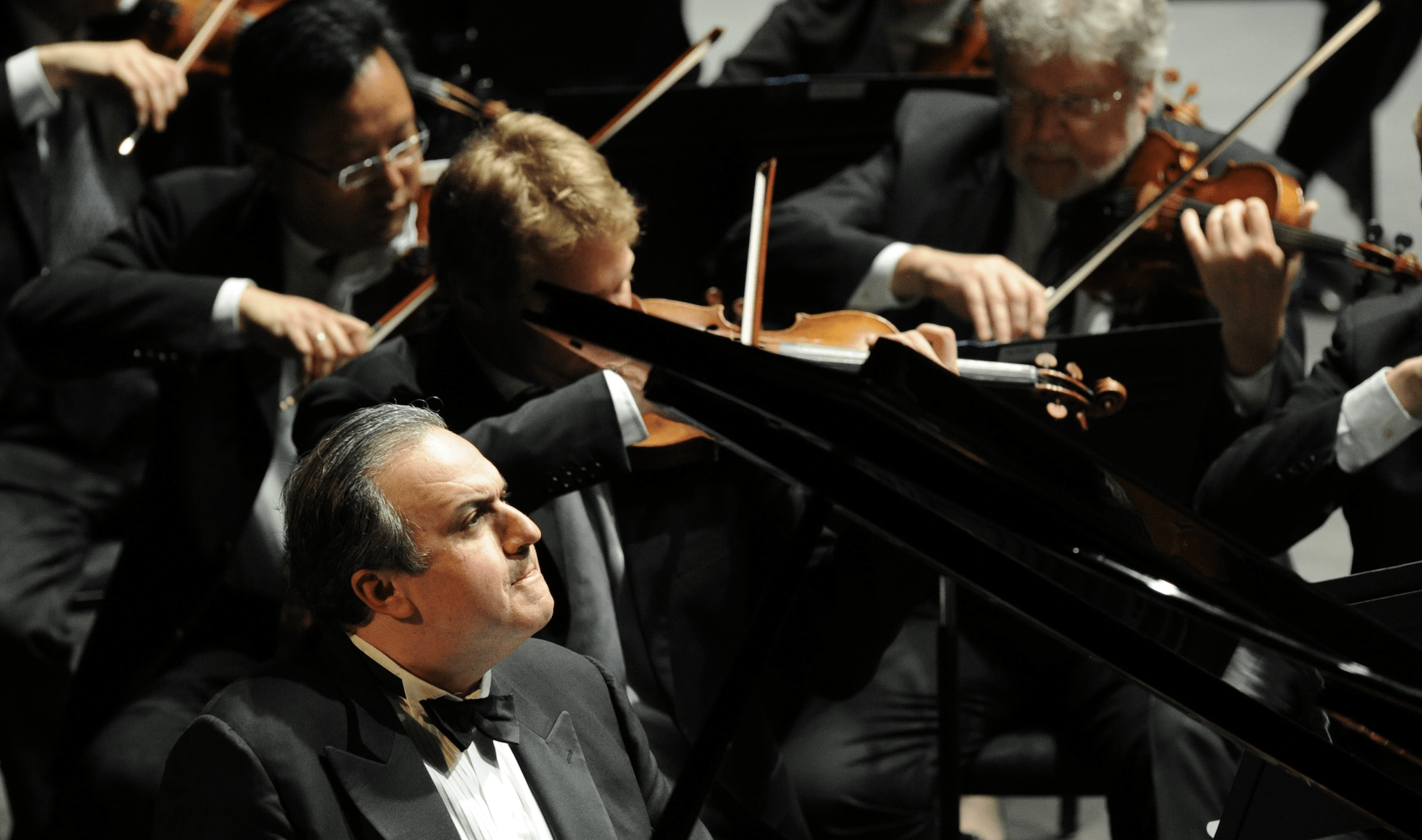
Yefim Bronfman, from top: lower left with orchestra; headshot. Photos courtesy and © LA Phil.